Water Main Replacement
MMU operates and maintains approximately 100 miles of water distribution mains. This distribution system is overall in excellent condition. As part of maintaining this system, aged water main does periodically need to be replaced.
We budget and plan for water main replacements years in advance, in specific areas based upon age of the main and failures (main breaks).
Funding
In 2023, MMU received a grant for water infrastructure improvements in the amount of $3.9 million. A portion of these funds were used for improvements to the North Street Pumping Station. The remainder of the grant funds were used to purchase about $630,00 worth of water main and related materials – enough to support several years of planned water main replacement projects.
Missouri DNR Grant Funded Water Main Replacement Projects
| Project | Progress |
| College Street from Grant to Lafayette Avenue | Completed 2025 |
| Park Avenue from Vest Street north | Completed 2025 |
| Bond Avenue from High Street to Wall Street | In Progress |
| Wall Street from Bond Avenue to Ted Avenue | In Progress |
| Ted Avenue from Wall Street to High Street | In Progress |
| English Avenue at Conagra | Planned start in 2026 |
| Rea Street from Brunswick Avenue to Sharp Avenue | Planned start in 2027 |
| Brunswick Avenue from Porter Street to Lacy Street | Planned start in 2027 |
| Eastwood Street from Park Avenue to Osage Drive | Planned start in 2027 |
| College Street from Brunswick Avenue to Sharp Avenue | Planned start in 2028 |
| Vest Street from Redman Avenue to Lincoln Avenue | Planned start in 2028 |
| Rea Street from Sharp Avenue to Lincoln Avenue | Planned start in 2028 |
| Sharp Avenue from College Street to Morrow Street | Planned start in 2028 |
| Ellsworth Avenue from Vest Street to Jackson Street | Planned start in 2029 |
| Washington Street from Lincoln Avenue to Brunswick Avenue | Planned start in 2029 |
| Thomas Street from Lincoln Avenue to Conway Avenue | Planned start in 2029 |
| Conway Avenue from Thomas Street to Washington Street | Planned start in 2029 |
| Lincoln Avenue from Eastwood Street to Thomas Street | Planned start in 2030 |
Water Main Replacement Process
Replacing water mains is an interesting process that involves many steps. The work cannot happen all at once and requires crews to return to the same block multiple times throughout the project. Planned water main replacement includes the steps below (emergency replacements or repair may follow different procedures):
- Locate underground utilities.
Underground lines and utilities such as power, communication, gas, water, and wastewater lines are located and marked on the ground (see what different colors represent). Additionally, crews will utilize potholing to accurately locate utilities throughout the project (this is typically done by hand digging with a shovel or use of a vacuum excavator). - Excavation and installation.
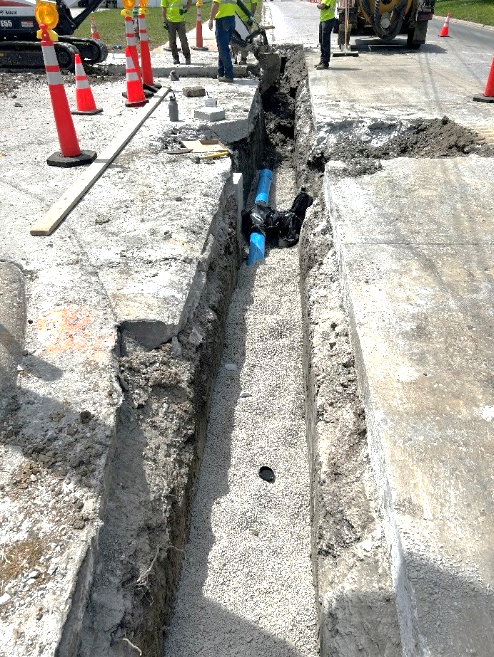
Crews use a saw to cut the street and remove asphalt and concrete from the area where the new water main will be placed. They excavate and dig a trench down to the appropriate depth for the new water main. The bottom of the trench is leveled and prepped to support the main and crews begin lowering the pipe into the trench. Pipe sections are connected together in the trench. - Backfill and temporary street restorations.
As they go, crews haul off excavated material and backfill the trench to the surface of the road, allowing traffic to return to the area as soon as possible. The backfill must be allowed time to settle to make sure proper compaction results before restoring the asphalt or concrete street surface. - Tie-ins.
As critical tie-in points are reached (typically in the intersection of another street), the new main will be tied-in to water mains that branch off of the main being replaced. The new main remains isolated from the existing water distribution system until later in the process. - Disinfection, flushing, testing.
Once the new main has been installed and tested for leaks, it is filled with water and disinfected. Afterwards, the new main is flushed and water samples are sent to a certified lab. Once water quality is verified, the new main is ready to serve customers. - Customer connections.
Each individual customer’s water service is connected to the new main. New excavation will occur in areas where the water main was installed in order to move these services from the old water main to the new. - Remaining tie-ins.
Once all customer services have been switched over to the new main, all the remaining tie-ins will be made to other existing water main. As with customer connections, this requires additional excavation in the previously excavated areas. - Repeat.
Crews will backfill again after making customer connections and completing tie-ins, allowing people to drive over the road once again. All backfill must be allowed time to settle to make sure proper compaction results before restoring the asphalt or concrete street surface. - Final street restoration.
Once the backfilled excavation areas have settled and compacted, repairs can be made to the street. - The old main.
The old main is disconnected from the water distribution system and we cap off both ends. This prevents soil issues from later occurring.